

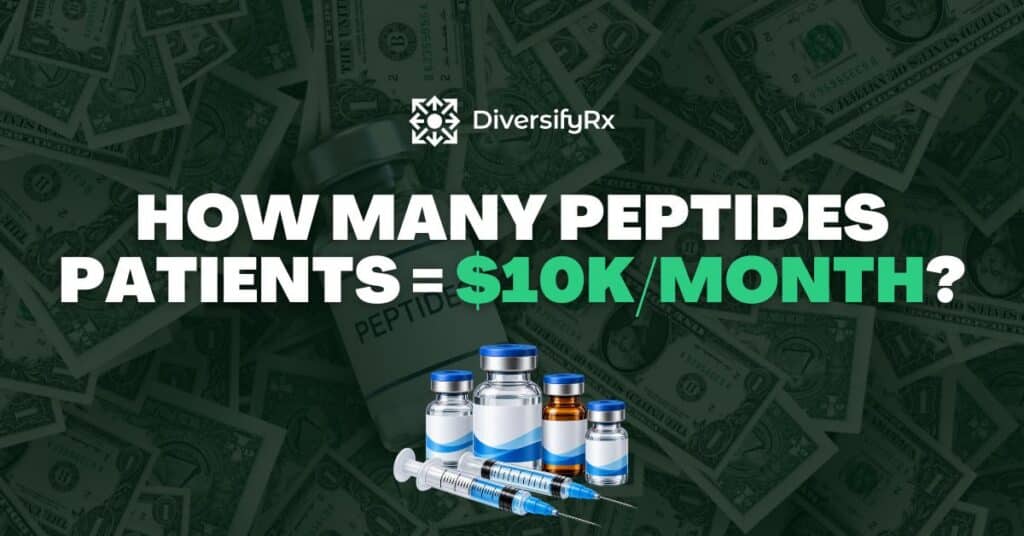

The $10,000 Question: How Many Peptide Patients Do You Actually Need?
The opportunity for peptide pharmacy revenue gets a whole lot more interesting when you stop talking about “market potential” and start doing the math.
Because your patients aren’t waiting for independent pharmacies to discover peptides.
They’re already hearing about them from providers, wellness clinics, podcasts, social media, friends, longevity people, weight-loss people, and probably that one guy at the gym who has VERY strong opinions about everything.
The demand and curiosity are already here.
We talked about this earlier this summer when I wrote about the FDA’s July Pharmacy Compounding Advisory Committee meeting and the seven peptide-related bulk drug substances being considered.
That meeting has now happened. The committee considered BPC-157, KPV, TB-500, MOTS-c, Emideltide (DSIP), Semax, and Epitalon.
That’s important regulatory movement, but before anybody gets too excited, the Pharmacy Compounding Advisory Committee is exactly what its name says: advisory. Its recommendations to FDA are non-binding, so pharmacy owners still need to pay very close attention to the regulatory status of the specific products and pathways they’re using.
We’ll come back to that.
Today, though, I don’t want to spend another 1,500 words talking about Washington.
I want to talk about your bank account.
Specifically:
What would it actually take for peptides to become a meaningful revenue stream in your pharmacy?
Not becoming the Peptide Capital of America or rebuilding your entire pharmacy around the latest wellness trend.
Let’s actually do the math.
Stop Asking Whether Peptides Are a “Big Opportunity”
I’ve spent a ridiculous amount of my career teaching pharmacy owners about new revenue streams.
And whenever something new gets hot, we tend to have the same conversation.
Is this a big opportunity?
Peptides are growing! Wellness is growing! Cash-pay is growing! Patients want this!
Okay.
But does it make money?
That’s the question I care about.
More importantly, does it make enough money to justify the time, training, marketing, workflow, and attention required to build it?
Because I’ve watched pharmacy owners get very excited about a new opportunity, buy a bunch of stuff, train half the team, make two Facebook posts…and six months later nobody can tell me whether the program made $50,000 or fifty bucks.
That’s not how I want you evaluating peptide pharmacy revenue.
Instead, start with the outcome.
Ask:
“What would this need to produce every month for me to care?”
Maybe your number is $5,000… or it’s $10,000… or maybe it’s $20,000.
Whatever the number is, now we have something useful to work backward from.
Calculate Your Peptide Pharmacy Revenue Backward
Here’s the first calculation I want you to make:
Desired Monthly Peptide Revenue ÷ Average Monthly Revenue Per Patient = Active Patients Needed
Simple.
Let’s say your goal is $10,000 per month.
I’m intentionally NOT going to give you some magical industry-wide “average peptide patient value” because your economics will depend on what you’re offering, how you’re participating, your pricing, your partners, your product mix, and how often those patients purchase.
Instead, pull your actual numbers.
If the average active patient produces $250 per month in revenue, you would need 40 active patients to reach $10,000.
If the average is $400, you’d need 25.
At $500, you’d need 20.
That’s a very different way to think about the opportunity, isn’t it?
Instead of saying: “We should get into peptides!”
you can say: “We need 25 active patients for this program to produce $10,000 per month.”
Now I can build a business plan around it.
And depending on your pharmacy, that number may be a whole lot smaller than you expected.
That’s the point of the exercise.
We’re turning a trend into numbers.
Revenue Is Nice. Gross Profit Pays the Bills.
Of course, I’m going to ruin our fun now.
Because $10,000 in revenue is NOT $10,000 in profit.
I love revenue as much as the next pharmacy owner, but revenue doesn’t pay your mortgage.
Profit does.
So once you’ve calculated your potential peptide pharmacy revenue, take the next step.
Start with the revenue and subtract the direct costs required to produce it.
Depending on your model, that could include:
- Product acquisition costs
- Shipping
- Merchant processing
- Direct labor
- Marketing
- Technology
- Partner or program costs
- Other expenses directly associated with delivering the program
Now ask yourself:
What is actually left?
I don’t care if you built a $20,000-a-month peptide program if it takes $19,500 and three nervous breakdowns to operate it.
What we’re looking for is meaningful, repeatable, profitable revenue.
This is also why I’ve been pushing pharmacy owners so hard to understand their non-PBM pharmacy revenue.
You don’t diversify just so you can brag about having seventeen different revenue streams.
You diversify because you want more profitable revenue that gives you greater control over your business.
Peptides may be one way to create it.
But the numbers still have to work.
Now Calculate the Number That REALLY Matters
Once you’ve figured out how many active patients you need, there’s another number I want.
How many conversations does it take to get one?
This is where the opportunity becomes operational.
Let’s say your goal requires 25 active patients.
You don’t wake up Monday morning and tell your team:
“Okay guys! We need 25 peptide patients!”
Cool. How?
Instead, start measuring the path:
People Reached → Conversations → Appropriate Prospects → Customers → Repeat Customers
For example, imagine your team has 20 appropriate conversations and five eventually become customers.
Again, that’s an illustration, not a benchmark.
But now you know something incredibly useful.
Your immediate goal isn’t:
“Build a $10,000 peptide program.”
It’s:
“How do we consistently create more of the right conversations?”
That is MUCH easier to manage.
- Maybe your staff starts identifying existing patients who are already asking about wellness options.
- Maybe you educate your community through email.
- Maybe you start making simple videos.
- Maybe you strengthen relationships with providers already serving these patient populations.
Either way, you’ve converted a giant revenue goal into a weekly activity your team can actually execute.
Your First Peptide Patients May Already Be in Your Pharmacy
This is where I think independent pharmacies have a HUGE advantage.
Years of filling prescriptions, answering questions, solving problems, and serving your community have already created something valuable:
Trust.
Along with that trust comes an existing patient base and relationships with local providers.
Meanwhile, many people walking through your pharmacy are actively spending money trying to improve their health outside of traditional prescription dispensing.
Wellness is getting their attention. Weight management and metabolic health are part of everyday conversations. Questions about healthy aging, recovery, sleep, body composition, supplements, and other ways to feel better are increasingly common.
For some of those patients, peptides are already on the radar.
So before deciding that peptide pharmacy revenue requires some gigantic advertising campaign, start with the audience you’ve already earned.
Talk to your patients.
Then educate your team so they’re prepared when questions arise. Communicate with appropriate providers, use your email list, create useful content, and pay attention to which conversations generate genuine interest.
From there, measure what happens.
That’s one of the reasons I’ve been so interested in this opportunity for independent pharmacies. PBU members already have several ways to participate in the peptide category, including education around compounding, 503B products, OTC options, and other appropriate pathways.
Building an entire peptide empire tomorrow isn’t the goal.
Finding a profitable starting point is.
Don’t Build a Peptide Pharmacy Revenue Empire. Prove the First $5,000.
If you’ve been reading my stuff for a while, you probably know where I’m going next.
Give the opportunity a real test.
I recently wrote about my 90-Day Revenue Stream Sprint because pharmacy owners have a nasty habit of confusing starting a revenue stream with actually building one.
Peptides shouldn’t get special treatment.
Give yourself 90 days to learn something useful.
Days 1–14: BUILD
First, understand your model.
Start by defining what you’re offering, who it’s for, which pathway you’re using, and what regulatory or compliance boundaries apply. From there, identify your partners and determine what your team needs to know.
Most importantly, understand the economics.
Set the revenue goal, determine the average revenue and gross profit you need per patient, and calculate the patient volume required to get there.
Days 15–45: MARKET
Next, go create conversations.
Existing patients are an obvious starting point, but they’re not the only one. Provider outreach, educational email, simple video content, and staff conversations can all help put the opportunity in front of appropriate people.
Most pharmacies dramatically underestimate how much marketing a new revenue stream needs because the owner knows it exists and assumes everyone else somehow does too.
They don’t.
Tell people.
Days 46–75: OPTIMIZE
By this point, you should have data.
Look at how many people you’re reaching and how many meaningful conversations are happening. Then compare those numbers with customers, repeat purchases, revenue, gross profit, and the amount of staff time required to produce the results.
Somewhere in that process, there’s usually a constraint.
Find it.
Then fix it.
Days 76–90: DECIDE
At the end of 90 days, choose:
SCALE IT.
FIX IT.
Or…
KILL IT.
Strong demand and healthy economics give you a reason to build more capacity and reach more people.
On the other hand, demand paired with a broken process tells you where improvement is needed.
And after a legitimate test, lousy economics are useful information too.
Move on.
There are too many ways for an independent pharmacy to make money to spend the next three years dragging around a revenue stream that refuses to cooperate.
One Important Reality Check About Peptides
Before somebody screenshots half this article and yells at me on Facebook, let’s make something VERY clear.
The July 2026 FDA Pharmacy Compounding Advisory Committee meeting was important.
During that meeting, the committee considered seven peptide-related bulk drug substances for possible inclusion on the 503A Bulks List: BPC-157-related substances, KPV-related substances, TB-500-related substances, MOTS-c-related substances, Emideltide-related substances, Semax-related substances, and Epitalon-related substances.
However, an FDA advisory committee does not make the agency’s final regulatory decision.
According to the FDA’s information about the July Pharmacy Compounding Advisory Committee meeting, these committees provide independent expert advice and make non-binding recommendations to the agency.
In other words:
Do not read “peptide opportunity” and translate that into “Lisa said I can compound whatever the heck I want now.”
I did not. 😂
Specific products, pathways, sourcing, state rules, federal requirements, and current regulatory status still matter.
In addition, FDA maintains information about safety concerns associated with certain bulk drug substances used in compounding, which includes several peptide-related substances.
For that reason, legitimate and compliant pathways matter just as much as the economics.
The opportunity can be exciting AND require regulatory discipline.
Those two things can exist at the same time.
Your Peptide Pharmacy Revenue Opportunity Has a Number
At this point, forget about whether peptides are “hot” for a minute.
Instead, answer five questions:
- What monthly revenue would make this opportunity worth pursuing?
- How much gross profit would that revenue actually produce?
- How many active patients would I need?
- How many conversations do I need each week to build that patient base?
- What would I need to execute over the next 90 days to find out whether this actually works?
With those answers in hand, peptide pharmacy revenue stops being some vague opportunity everybody keeps talking about.
Now it’s a business model you can evaluate.
Perhaps the number is 20 active patients. Another pharmacy might need 40. In some cases, the economics may tell you this isn’t the right opportunity at all.
GOOD.
Now you know.
The goal isn’t to chase every shiny new revenue stream that wanders across your Facebook feed.
It’s to identify the right opportunities, understand the numbers, and execute the heck out of the ones that make sense.
One Last Thought on Peptide Pharmacy Revenue
Pharmacy owners tell me constantly that they want more cash-pay revenue, less PBM dependence, better margins, and greater control over where their money comes from.
I want all of that for you too.
However, those revenue streams don’t magically appear because you wrote DIVERSIFICATION on your goal sheet.
Somebody has to build them.
That process means choosing an opportunity, understanding the economics, creating the system, telling people about it, measuring the results, and improving what works.
Peptides may or may not become a $10,000-a-month revenue stream in your pharmacy.
After doing the math, though, you’ll know whether the opportunity deserves your attention.
And that’s infinitely more useful than standing on the sidelines for another six months saying:
“Yeah…I’ve been meaning to look into peptides.”
Want Help Actually Building It?
If the numbers make sense and you’re ready to explore peptides more seriously, don’t start from scratch.
Inside Pharmacy Badass University, we’ve already built out peptide education, implementation resources, marketing tools, and access to partners that can help pharmacy owners participate through appropriate pathways.
Learn the opportunity. Understand the rules. Then actually IMPLEMENT it.
Because knowing peptides could make your pharmacy money is nice.
Building the revenue stream is better.