


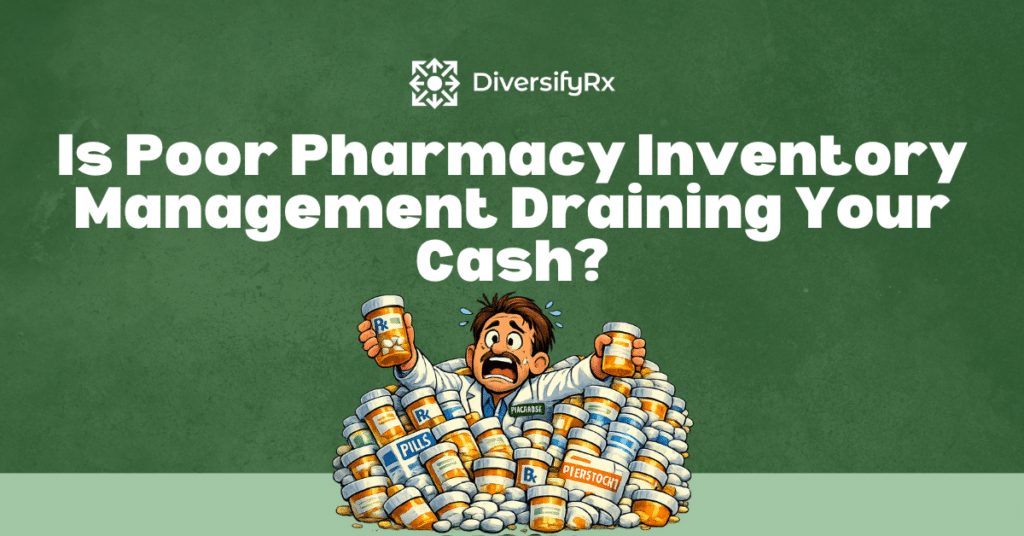

Let’s talk about the very expensive little pharmacy inventory management problem sitting on your shelves…
Inventory.
Cute, isn’t it?
All those bottles sitting there quietly like they’re innocent, when really some of them are just tiny cash vampires wearing NDC numbers.
And yes, I know inventory is necessary. You can’t run a pharmacy with empty shelves and good intentions. Patients need medications, your team needs product to fill prescriptions, and nobody wants to tell Mrs. Johnson her medication will be here “maybe Thursday-ish.”
But here’s the part many owners miss: too much inventory can quietly choke your cash flow.
Not dramatically. Not all at once. Just slowly, month after month, until you’re looking at your operating account wondering why your pharmacy is so busy and still feels tight.
That’s why pharmacy inventory management is not just an operations issue.
It’s a cash-flow issue and a profitability issue.
And, some weeks, it’s a “Can I sleep tonight or am I mentally calculating wholesaler drafts at 2:17 a.m.?” issue.
What Is Pharmacy Inventory Management?
Pharmacy inventory management is the process of controlling what medications and products your pharmacy orders, stocks, replenishes, and removes so you can meet patient demand without tying up unnecessary cash. Strong inventory management improves cash flow by reducing overstock, slow-moving products, expirations, and unnecessary high-dollar purchases.
Why Inventory Gets Out of Control So Easily
Most pharmacy inventory management problems don’t happen because an owner is careless.
They happen because pharmacy is chaotic.
A patient needs something urgently. A prescriber changes a dose. A staff member orders “just in case.” Someone doesn’t check the shelf first. A product gets ordered from the wrong vendor. A high-dollar drug comes in, sits there, and suddenly it has become a very expensive decoration.
And because inventory feels like patient care, it’s easy to justify.
- “We might need it.”
- “They asked for it last month.”
- “I don’t want to be out.”
- “I’d rather have it than lose the patient.”
All of that makes sense in the moment. But over time, “just in case” ordering becomes “where did all our cash go?” ordering.
That’s the trap.
How Poor Pharmacy Inventory Management Hurts Cash Flow
When inventory sits on your shelf, that money is not available for anything else.
Not payroll, or for marketing, or for vendor opportunities, and definitely not for repairs.
Not your own paycheck (which I’m personally a fan of owners actually taking).
Inventory ties directly to cash flow because every dollar sitting in slow-moving stock is a dollar you can’t use somewhere else. Industry guidance around independent pharmacy inventory consistently points to the same core issue: overstock and poor inventory practices tie up valuable cash and can hurt gross margins.
And the painful part is that the owner usually feels the squeeze before they see the pattern.
You don’t always notice one extra bottle here or one slow-moving item there.
But your bank account notices. Your wholesaler draft notices. Your expired products notice.
Very rude of them, honestly.
The Goal Is Not “Less Inventory”
This is important.
The goal is not to starve your shelves.
If you cut inventory too aggressively, you create a different problem. You frustrate patients, create more partial fills, slow down workflow, and make your team want to throw the phone into the parking lot.
The goal is better pharmacy inventory management.
Tighter inventory.
Smarter inventory.
The right product, in the right quantity, turning at the right pace.
That’s where pharmacy inventory management becomes powerful. You’re not trying to win an award for the emptiest shelves. You’re trying to stop letting your cash sit around doing nothing.
Improve Pharmacy Inventory Management by Finding Slow Movers
If you want a simple place to start, look at your slow movers.
Every pharmacy has them.
Products that came in for one patient who disappeared into the mist… or products that made sense six months ago but haven’t moved since… or products that everybody assumes “someone probably needs,” even though no one has seen that someone since the Obama administration.
Pull a slow-mover report and actually look at it.
Not glance at it while eating lunch over the keyboard.
Actually review it. Ask:
- What has not moved in 90 days?
- What has not moved in 180 days?
- What do we keep reordering that barely turns?
- What high-dollar items are tying up cash?
This is where you start finding trapped money.
Watch the “Just in Case” Habit
“Just in case” is one of the most expensive phrases in pharmacy.
I’m not saying there is never a reason to keep certain products on hand. Of course there is. You know your patients and your community.
But there needs to be a difference between a smart stocking decision and anxiety ordering.
A smart decision is based on data.
Anxiety ordering is based on fear. That fear usually sounds like:
- “What if someone needs it?”
- “What if we lose the patient?”
- “What if we can’t get it later?”
Again, understandable.
But if you run your pharmacy inventory management based entirely on fear, your cash flow will feel it.
A simple rule helps here: expensive or unusual products should have a reason, a patient, a plan, and a follow-up process.
If not, be careful.
Tighten Reorder Points
Reorder points can either protect your cash flow or quietly sabotage it.
If they’re too high, you carry more product than you need. If they’re too low, you run out and create chaos.
Neither is fun.
This is why you should periodically review reorder points, especially for products with changing demand. Just because a reorder point made sense last year does not mean it still makes sense today.
Things change.
- Prescribing patterns change.
- Patient mix changes.
- Seasonal demand changes.
- Your staff changes.
Your system settings should not be treated like ancient scripture carved into stone tablets.
Review them. Adjust them. I promise your shelves will not be offended.
Use Secondary Vendors Strategically
This is one of those areas where owners can often find margin improvement and cash-flow relief.
Your primary wholesaler matters, but blind loyalty can get expensive.
Sometimes the best pharmacy inventory management decision is not just what you order, but where you order it from.
A smart purchasing strategy includes comparing pricing, watching availability, using secondary vendors when appropriate, and making sure the team understands the rules.
The key word there is rules.
Because if every person orders based on vibes, chaos wins.
Set clear guidelines:
- When do we use the primary?
- When do we check secondary vendors?
- Who approves expensive purchases?
- What counts as urgent?
- What must be verified before ordering?
A little structure here can save a lot of money.
Pay Special Attention to High-Dollar Drugs
High-dollar medications deserve their own level of discipline.
One expensive product sitting too long can make your cash flow feel like it got punched in the face.
For these items, consider tighter ordering policies:
- Confirm the patient still wants it
- Confirm the copay
- Confirm pickup or delivery timing
- Avoid keeping unnecessary supply on hand
- Use next-day ordering where appropriate
This is especially important with products that have uncertain demand or high acquisition cost. Pharmacy inventory management guidance often emphasizes minimizing the amount of expensive drugs sitting on the shelf and coordinating with patients and distributors when possible.
That one extra step before ordering can save you from owning a very expensive box of regret.
Improve Your Expiration Process
Expired product is cash that died on the shelf.
That sounds dramatic, but it’s true.
Every expiration is a little reminder that at some point, money came into your pharmacy, got turned into inventory, sat there too long, and then left the building as waste.
Not my favorite business model.
Your expiration process does not need to be fancy, but it does need to be consistent.
Have someone responsible for checking short-dated items and move products before they expire when appropriate.
And definitely make sure to track patterns.
If the same categories keep expiring, that’s not random. That’s information.
Track Inventory Turns to Improve Pharmacy Cash Flow
Inventory turns are one of the best ways to understand whether your inventory is working for you or sitting there collecting dust and judging you.
In simple terms, inventory turns show how quickly you’re moving through inventory over a period of time.
Low turns usually mean too much cash is sitting on the shelf.
Higher turns usually mean inventory is moving more efficiently.
The exact target can vary by pharmacy, but the principle is the same: if your inventory is not turning, your cash is not moving.
And cash that does not move is cash you can’t use.
(Since this is one of the BIGGEST ways you can improve your cash flow, I have a blog that goes deeper into this topic. Check it out here).
A Simple Weekly Inventory Check-In
If you want to make this practical, start with a simple weekly check-in.
Ask these five questions:
- What high-dollar items are sitting longer than expected?
- What slow movers need attention?
- What did we order urgently this week and why?
- What expired or is close to expiring?
- What reorder points need adjusting?
That’s it.
Five questions.
You don’t need a 47-tab spreadsheet named “Inventory Final FINAL v6.”
You just need a simple rhythm that helps you create control.
Better Pharmacy Inventory Management Creates Better Cash Flow
If your pharmacy feels busy but your cash flow still feels tight, your pharmacy inventory management is one of the first places I would look.
Not because it’s always the only issue.
But because it’s one of the biggest levers you can actually control.
PBMs may do PBM things.
Reimbursements may lag.
Wholesaler drafts may hit at the worst possible moment because apparently that is their love language.
But inventory?
That’s something you can tighten.
If you know your inventory is a problem, Pharmacy Badass University is the exact thing that can help you. I have a whole step-by-step training on managing your inventory to add anywhere between $5K – $10K in cash flow to your pharmacy. Go check it and see why 330+ pharmacy owners are part of the University and growing profitable pharmacies.