


Headlines First, Reality Later
If you’ve been in pharmacy longer than five minutes, you already know this routine.
A president signs an executive order. The headlines go wild. Patients, staff, and random relatives at Thanksgiving ask: “So… does this change anything tomorrow?”
Short answer: no. Long answer: also no — but something does start moving.
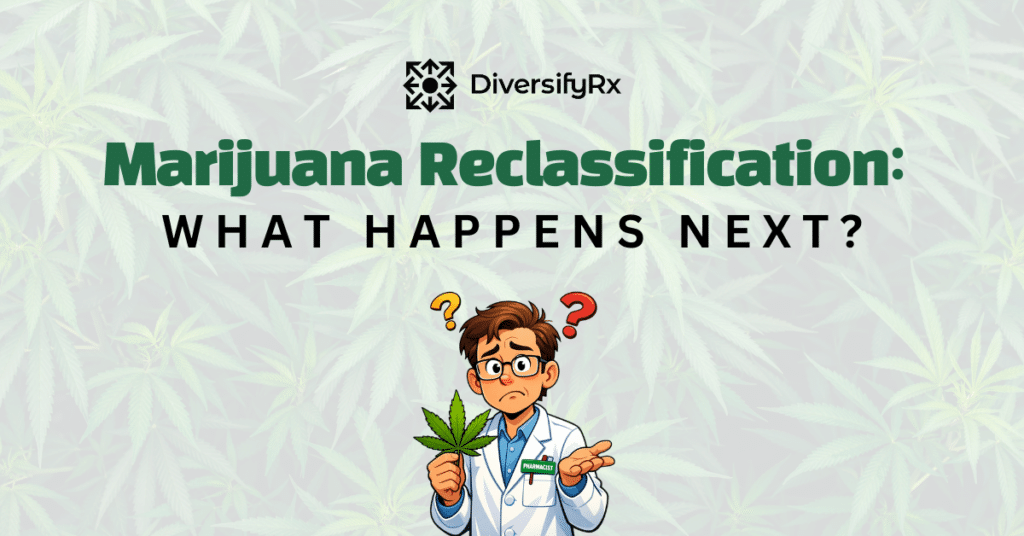
President Trump’s executive order directing federal agencies to revisit marijuana’s classification under the Controlled Substances Act is one of those moments. It doesn’t flip a switch, but it starts a process — and that process matters for pharmacies paying attention to the long game.
Let’s talk about the actual marijuana reclassification pharmacy impact without the hype, politics, or wishful thinking.
What the Executive Order Actually Does (And Doesn’t Do)
First, let’s clear up the biggest misconception.
An executive order does not change the law.
What it does is instruct federal agencies — mainly HHS, FDA, and the DEA — to begin a formal review of marijuana’s current classification.
Today, marijuana sits in Schedule I, which means it’s officially defined as having:
- No accepted medical use
- High potential for abuse
- No accepted safety under medical supervision
The executive order essentially says:
“Re-evaluate whether marijuana still meets those criteria.”
That’s it. No rescheduling happens the day the pen hits the paper.
What This Executive Order Actually Sets in Motion
Behind the scenes, three very slow gears start turning.
1. Scientific and Medical Review
HHS and FDA begin reviewing:
- Existing clinical and medical evidence
- Accepted medical use
- Safety data
- Abuse potential compared to other substances
This is the same pathway used for other controlled substance changes in the past — and it’s methodical, not fast.
2. DEA Rulemaking
If HHS recommends a change, the DEA must:
- Propose a new rule
- Open public comment periods
- Conduct internal review
- Publish a final rule
This process is intentionally slow and legally cautious.
3. Federal Enforcement Guidance
Even before any final decision, DOJ and DEA may quietly:
- Adjust enforcement priorities
- Issue internal guidance
- Reduce aggressive federal posture
This doesn’t change pharmacy operations overnight — but it’s a signal worth watching.
How Long This Will Actually Take
Realistically? 12 to 36 months is a reasonable expectation.
Why so long?
- Controlled substance scheduling is heavily documented
- DEA moves cautiously (always)
- Final rules can be legally challenged
This is not fast. And it’s not guaranteed. But it is meaningful.
What Reclassification Could Look Like
Based on current discussions, here are the realistic scenarios.
Schedule III (Most Likely)
- Similar to anabolic steroids or certain barbiturates
- Recognized medical use
- Prescribable, but controlled
- Requires DEA registration, inventory controls, and recordkeeping
Schedule II (Less Likely)
- Similar to opioids or stimulants
- Highly restrictive
- Unlikely due to abuse concerns
Full De-Scheduling (Highly Unlikely Federally)
- Would require congressional action
- Not something an executive order can do
What This Means for Pharmacies (Eventually)
This is where pharmacy owners should stop scrolling headlines and start thinking strategically.
1. Marijuana Is Not Becoming a “Normal Prescription”
Even if moved to Schedule III:
- It won’t instantly show up in retail pharmacies
- FDA approval pathways still apply
- Formulations, dosing, and indications must be defined
Think long runway, not next quarter.
2. DEA Compliance Will Still Be a Big Deal
If marijuana becomes Schedule III, pharmacies would need:
- DEA registration
- Inventory controls
- Security and recordkeeping
In other words, this becomes a compliance-heavy category, not a casual add-on.
3. Cannabinoid Questions Will Increase
Independent pharmacies should expect:
- More patient confusion
- More prescriber questions
- More interest in FDA-approved cannabinoid products
Education becomes the differentiator. Pharmacies that can clearly explain:
- THC vs CBD
- Approved vs non-approved products
- Drug interactions
- Controlled vs non-controlled status
…will earn trust.
4. Expect a Long Gap Between Policy and Practice
Even after rescheduling:
- FDA approvals take years
- Supply chains lag
- Prescriber comfort takes time
- Payers will move slowly (or resist entirely)
We’ve seen this pattern before with ketamine, psychedelics, peptides, and early GLP-1 adoption.
5. The Bigger Signal for Pharmacy
This executive order isn’t just about marijuana.
It signals:
- Willingness to revisit outdated drug classifications
- Recognition that science evolves
- Openness to procedural reform
That matters for future conversations around pain management, mental health treatments, and other controlled substance reforms.
What I Recommend Pharmacy Owners Do Right Now
Not panic. Not invest. Not rebrand your front window.
Instead:
- Stay educated
- Watch DEA and FDA communications
- Prepare your team to answer patient questions calmly
- Strengthen controlled substance SOPs
- Position your pharmacy as an evidence-based educator, not an advocate or opponent
The pharmacies that win long-term are the ones that prepare quietly while everyone else reacts loudly.
Bottom Line
This executive order doesn’t change pharmacy practice today.
But it starts a clock.
And in pharmacy, the slow clocks are often the ones that reshape entire categories.
The smart move isn’t chasing headlines. It’s understanding the system and being ready when it finally catches up.
Want to get personalized guidance on how to grow your pharmacy to take advantage of updates like these? I have Open Office Hours for members of Pharmacy Badass University where I give detailed, step-by-step strategies to make your pharmacy the go-to source for your patients and community. Come check it out here and take your pharmacy to the next level.